Its Earth Day today, so I wanted to share a piece I wrote around Earth Overshoot Day last year. If you’ve never heard of either, consider Earth Day as a day to celebrate the Earth (a bit like mother’s day, we should appreciate her every day but we need a specific day to remind us), and Earth Overshoot Day as a day of mourning, and a call to action, because we’ve pushed the Earth further than it can sustain.
It seems fitting to share this piece in these times, as one of the main (/many!) flaws to my proposal was that surely countries would never enforce a change that would voluntarily jeopardise its perpetual economic growth?! But they have. Lockdowns are in place globally. And economic growth has ground to a halt. This shows we do have the power to keep our Earth healthy. If we choose to. As we choose to keep ourselves healthy. We’ve proved we have the ability, when it comes down to it.
Earth Overshoot Day will come around again this year. I’m assuming it’ll be later compared to last year as production and consumption has slowed. I wonder how much later it’ll be. My guess is quite a lot. Don’t you think?
What fundamental economic and political change, if any, is needed for an effective response to climate change?
In the last 50 years we have depleted the Earth’s resources at an exponential rate. In 2019 we have used in seven months what the Earth can produce in twelve. Earth Overshoot Day is estimated to be 29th July, after which all consumption depletes resources, compared to the 29th December in 1970. A bi-product of our consumption is climate change which, considering the climate’s impact on weather conditions and ecosystems, makes this arguably the most imminent threat to human life on Earth. To determine an effective global response to the climate change threat, our need to consume more than the Earth can produce must be understood.
Why do we ‘need’ things?
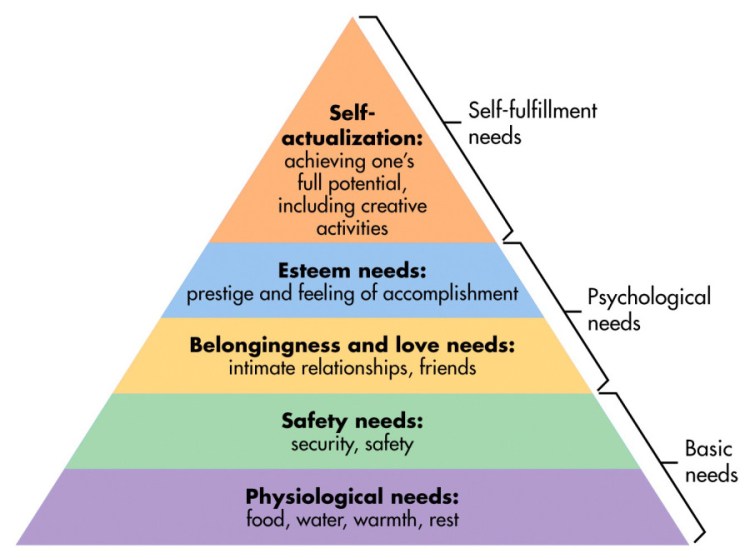
Through the lens of Maslow’s hierarchy of needs, society is built in response to an innate human desire to reach the top of the pyramid, attaining self-actualisation. We developed society as a means to fulfil the lower needs, attempting to meet needs for food and water, shelter and safety, our social need for belonging, and the need of our ego to have power and self-esteem. In our attempt to reach our ‘full potential’, society was built to grow, instilling our need for more consumption and basing success on perpetual GDP growth.
The ideas generated through modern society, such as modern medicine, machines and legal systems suggest society’s growth has had some success in meeting the lower needs. However, with increased population and development, the growth supposedly propelling us to the top will in fact send us plummeting to the base unless we find a way to fulfil our needs sustainably. Given society’s recent turn to material consumerism to fulfil esteem and belonging needs, this global mentality needs to be deconstructed, shifting purchases to more sustainable products and replacing material consumerism with other desires. Achievement of this would cause economic slowdown and is thus ignored by governments but with the climate’s imminent changes and borderless nature, thought should be given as to how a rapid, global response can be achieved.
Consumer behaviour must change
Firstly, the fashion of excessive consumption and excessive waste, developed to fulfil our esteem and belonging needs, must trend towards sustainable consumption like recycling, upcycling or cycling. Already, users of hashtags such as #refusethestraw are finding belonging by joining environmental campaigns such as that to save turtles. While not making any substantial lifestyle changes, hashtaggers demonstrate how consumers are receptive to environmental considerations if it makes them feel good or that they belong to a movement. Education and advertisement campaigns must utilise this tendency, normalising and demonstrating the necessity of sustainable behaviour. Airbrushed advertisements selling unnecessary products through subliminal messages of inadequacy need to be outnumbered with adverts to normalise sustainable behaviour.
How can this be achieved?
This could be financed by a national indirect tax raised on products producing the greatest environmental cost for the least social benefit. Examples include fast fashion, single-use plastics and technology built for rapid obsolescence. Using an indirect tax to combat climate change is not new. The EU’s Emission Trading Scheme was the first to make carbon-emitting behaviour more expensive in 2005, and there are numerous national carbon taxes, notably the Canadian scheme launched in 2016. This proposal adds tax to unnecessary consumption as well as carbon, utilising funds to shift consumer desires.
Businesses need to change too
To catalyst this shift, businesses must facilitate sustainable consumption. While indirect taxes and a change to consumer desires will result in a natural shift towards sustainable businesses, coercive regulation will also be required. Purchasing spare parts to fix a broken product or newly released updates to retro-fit an existing product needs to be commonplace and affordable.
Again, these are not new ideas. Parts of a Fairphone can be replaced or updated if desired and the EU’s Right to Repair legislation is set to coerce companies into making white goods more repairable from 2021, aiming to backtrack on the doubling replacement rates of these products within 5 years between 2004 and 2013.
Behaviour change IS possible
The inevitable slowdown of economic growth resulting from a change to the material consumerism trend has prevented countries successfully addressing the climate change threat, but it can no longer be ignored for the sake of monetary wealth. As the change is not a visible direct benefit to wealth, enjoyment or convenience, campaigns and education must explain the individual benefit of a sustainable Earth, as well as directing individuals towards alternative desires to fulfil psychological needs currently fulfilled by material consumerism.
The willingness of individuals to behave in a certain way to climb Maslow’s hierarchy of needs means necessary change is possible. For example, many women began shaving their underarms and legs in 1915 only after Gillette’s clever advertising of a female razor to double its customer base, and many men tie a piece of cloth around their neck when society indicates they should look smart. Both behaviours are triggered by a social need to belong with far less than the Earth’s ecosystems at stake.
We’re on the wrong route
To date, the world’s response to climate change has been to regulate greenhouse-gas-emitting activities. Attempts, such as the Paris Agreement in 2016, have been relatively unsuccessful, with greenhouse gas emissions still rising three years after it’s signing. These policies ignore that the threat of climate change to human life has been caused by a society built on its members’ quest for self-actualisation, and that society must change its route to the top if it is to survive. Effective regulation begins with an indirect tax to shift behaviour of the consumer, with proceeds being spent on national and global campaigns to change the individual’s desires for psychological need fulfilment. Additionally, regulation must coerce profit-driven business into producing affordable spare parts and retro-fittable products. This proposal leverages existing climate change policies, extending them to target the material consumerism at society’s core. Society cannot ignore that while we look to material possessions to fulfil our esteem and belonging needs we will perpetually ‘need’ more. On this route we will never reach self-actualisation but eventually the Earth will not be able to sustain us and we will descend into a struggle to fulfil even our basic needs.
I hope you enjoyed a slightly different read to my usual writing! I found this essay yesterday while rooting through old files and the timing seemed like too much of coincidence not to post it on here today.
If you do one thing today, find something you appreciate about our Earth. The more we appreciate it, the more we see how magical it is. The perfect formation of flowers and leaves. The bright blue of the sky. The intricacy of the human body. The vast number of different organisms that co-inhabit our world. The simplicity of fresh air. Happy Earth Day!
And a link to details about Earth Overshoot Day, if you want to know more!
 oaklake.uk